
When choosing an electric drive for a machine or conveyor belt, you are faced with a technical consideration: do you choose an asynchronous or a synchronous motor?

Both types have more than proven their reputation in industry. The right choice mainly depends on the requirements your process places on accuracy, temperature and energy consumption.
In this article, we clearly compare how they work, the practical differences and their applications.
How it works: the difference in the rotor
The distinction between the two motor types lies in the difference in speed between the rotor (the “rotating” part) and the magnetic field in the stator (the stationary “static” part).
The asynchronous motor (induction motor)
In an asynchronous motor, the rotor always runs slightly behind the rotating field of the stator. This difference in speed is called slip. Without slip, the motor cannot induce voltage in the rotor and no torque is generated.
- Construction: Simple and built for heavy-duty use.
- Control: Can be connected directly to the mains (Direct-On-Line) for a fixed speed, or controlled via a frequency inverter for an adjustable speed.
The synchronous motor (permanent magnets)
In a synchronous motor, there is no slip. Permanent magnets in the rotor ensure that the rotor runs exactly in sync with the rotating field of the stator.
- Construction and cooling: Highly efficient and cooler than comparable asynchronous motors. We deliberately assemble our synchronous motors in the familiar IEC design and mounting dimensions. We do not use this additional space to make the motor smaller, but to provide more cooling surface. This gives the motor a large thermal reserve and keeps it cooler, even at varying speeds and partial loads.
- Control: A frequency inverter is always required.
The key differences at a glance
To make the choice clear, we compare the motors based on a number of critical characteristics.
|
Characteristic |
Asynchronous motor |
Synchronous motor |
|
Speed |
Changes slightly with varying loads (slip) |
Runs synchronously with the set field |
|
Efficiency |
Good (IE3/IE4), decreases at partial load |
Very high (IE4/IE5), also at partial load |
|
Control |
Directly from the mains or via frequency inverter |
Frequency inverter required |
|
Design |
Standard IEC dimensions |
Standard IEC dimensions (with additional thermal reserve) |
|
Purchase costs |
Economical to purchase |
Higher (due to permanent magnets and frequency inverter) |
|
Maintenance |
Very robust and easy to maintain |
Robust, disassembly requires care due to the strong magnets |
When should you use which motor type?
The asynchronous motor: the industrial all-rounder
Asynchronous motors form the basis of many production lines and are ideally suited for long-term continuous operation. They are the most logical choice when robustness and a low purchase price are decisive.
- Widely used in the food industry: Think of cutting blades, mixing systems and pumps.
- Constant speed: Ideal for installations that continuously operate at one speed on the mains supply.
- Simplicity: Suitable for applications where a frequency inverter is not required or desired.
The synchronous motor: for precision, efficiency and cool operation
Synchronous motors are particularly suitable when a very constant speed, low energy consumption or minimal heat generation is important.
- Predictable conveyor speed: Because a synchronous motor has no load-dependent slip, the speed remains very constant under varying loads. For applications with high requirements for speed or positioning, an encoder can be used.
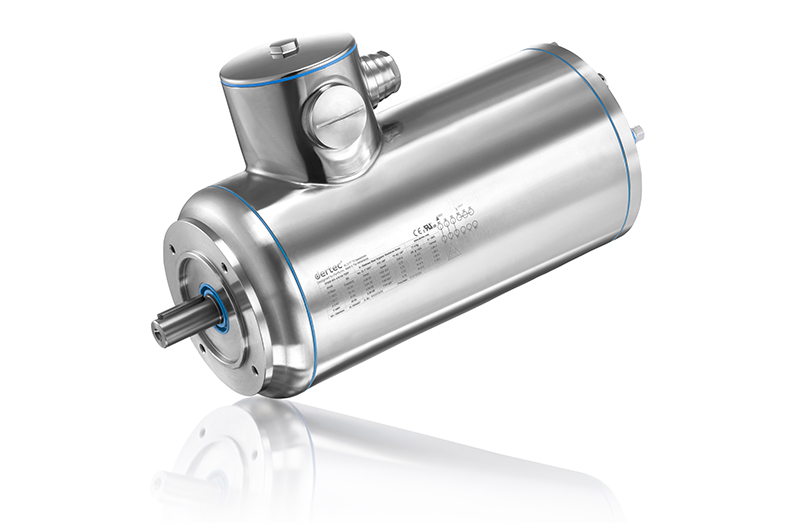
- Minimal heat generation: Because the electrical losses in the rotor are very low, the motor generates less heat and provides a greater thermal reserve. This makes this type particularly suitable for enclosed, smooth stainless steel housings in hygienic environments.
- Lower energy consumption (TCO): Especially with many operating hours and varying loads, the higher efficiency can provide a significant advantage in terms of Total Cost of Ownership (TCO).
Tailored advice for your drive system
Which motor type is best depends entirely on the application. If you choose an asynchronous motor, you choose an affordable and robust basis. A synchronous motor requires a higher initial investment, but provides you with a constant speed, minimal heat generation and lower energy consumption.
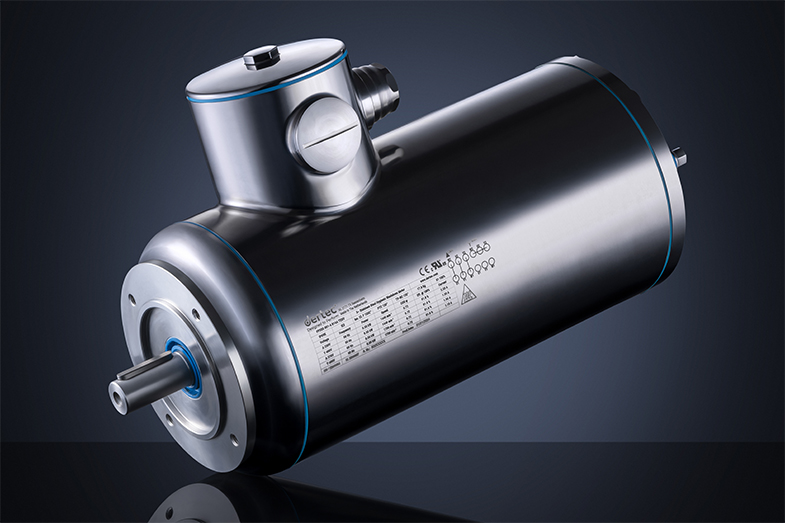
At Dertec, we supply both asynchronous and synchronous motors in our hygienic stainless steel versions. We are happy to help you determine which solution is technically and economically best suited to your application.